Processing damp, sticky, or clay-laden fine materials has long been one of the toughest operational bottlenecks in bulk material handling. Traditional circular or linear vibrating screens quickly suffer from severe screen blinding (mesh plugging) when handling feeds with moisture levels exceeding 6%…
Processing damp, sticky, or clay-laden fine materials has long been one of the toughest operational bottlenecks in bulk material handling. Traditional circular or linear vibrating screens quickly suffer from severe screen blinding (mesh plugging) when handling feeds with moisture levels exceeding 6% to 15%.
Once apertures become clogged, screening efficiency drops drastically, recirculating loads overload downstream crushers, and operators are forced into frequent, costly manual washdowns.
The SENKE Flip Flow Screen (Relaxation Screen) is engineered specifically to eliminate aperture blinding. By utilizing dual-resonance excitation and highly elastic polyurethane screen panels that continuously expand and contract at accelerations up to 30G–50G, the flip flow screen delivers continuous, maintenance-free dry classification for fine, damp materials down to 1 mm.
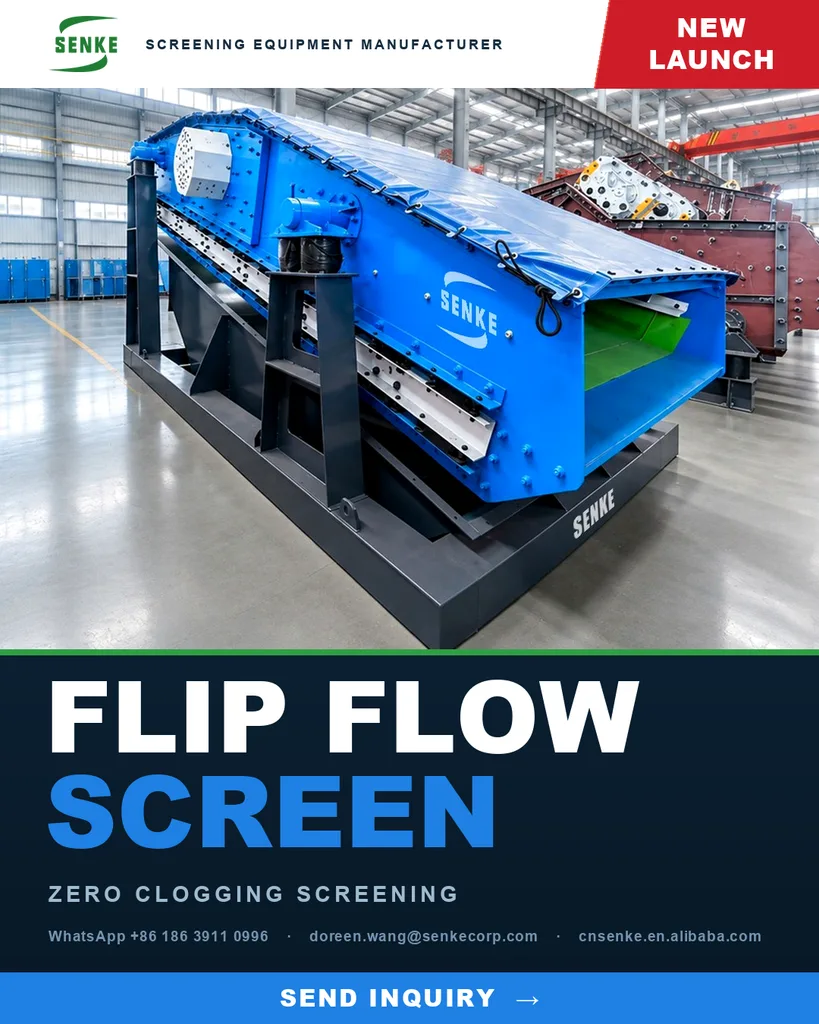
1. How Flip Flow Screening Mechanics Prevent Blinding
Traditional screens vibrate the entire machine basket as a rigid box, imparting only 3G to 5G of acceleration to the material bed. This is insufficient to overcome the surface tension of wet sticky particles.
The flip flow screen operates on a dual-body resonance principle:
- Dynamic Expansion & Contraction: The screen consists of an outer primary frame and an inner counter-frame driven by eccentric shafts. The two frames oscillate relative to each other with a phase displacement.
- 50G High-Energy Particle Ejection: Highly flexible polyurethane screen mats fastened between the alternating crossbars are continuously tensioned (stretched) and relaxed (slackened). When snapped taut, the mats generate local accelerations up to 50G.
- Fluidized Material Bed: This violent snapping action breaks cohesive bonds between sticky particles, fluidizes the material bed, and forcefully ejects near-aperture particles that would otherwise wedge into traditional wire mesh.
2. SENKE Flip Flow Screen Technical Specifications Matrix
| Technical Specification | Compact Unit (FFS1236) | Commercial Unit (FFS1860) | Heavy Industrial (FFS2472) |
|---|
| Effective Screen Width | 1,200 mm (3.94 ft) | 1,800 mm (5.90 ft) | 2,400 mm (7.87 ft) |
| Effective Screen Length | 3,600 mm (11.81 ft) | 6,000 mm (19.68 ft) | 7,200 mm (23.62 ft) |
| Screen Deck Area | 4.32 m² | 10.80 m² | 17.28 m² |
| Separation Cut Points | 1 mm – 15 mm | 2 mm – 25 mm | 3 mm – 35 mm |
| Processing Capacity | 30 – 70 t/h | 100 – 220 t/h | 250 – 500 t/h |
| Polyurethane Acceleration | Up to 45G | Up to 50G | Up to 50G |
| Drive Motor Power | 11 kW – 15 kW | 22 kW – 30 kW | 37 kW – 45 kW |
| Deck Deck Configuration | Single / Double Deck | Single / Double Deck | Single / Double Deck (Top 3D Banana / Bottom Flip Flow) |
| Material Moisture Limit | Up to 18% – 25% | Up to 18% – 25% | Up to 18% – 25% |
3. Demanding Industry Applications
A. Raw Coal & Coal Gangue Preparation
Screening damp raw coal at 3 mm, 6 mm, or 13 mm without adding wash water. Prevents boiler coal slurry build-up while saving water resources in arid mining basins.
B. Sand & Gravel Aggregate Fines (0–3 mm / 0–5 mm)
Dry sizing of manufactured sand (M-sand), limestone dust, and damp quarry scalpings without mesh blinding, maintaining high grading accuracy.
C. Incineration Bottom Ash (IBA) & Slag Recycling
Separating fine ash from metallic granules and unburnt clinker, allowing efficient recovery of precious non-ferrous metals and clean structural aggregate.
D. Municipal Solid Waste (MSW), Compost & Biomass
Handling high-moisture organic compost, damp shredded wood chips, shredded tires, and landfill reclamation materials prone to stringy plugging.
4. Key Advantages: Flip Flow Screen vs. Traditional Vibrating Screen
| Performance Dimension | Traditional Woven Mesh Screen | SENKE Flip Flow Screen |
|---|
| Screening Acceleration | 3G – 5G (Rigid Frame) | 30G – 50G (Elastic Polyurethane Mat) |
| Moisture Tolerance | Max 5% – 7% (Blinds easily) | Up to 18% – 25% (Zero Blinding) |
| Cleaning Maintenance | Requires daily manual jet washing | Self-cleaning continuous operation |
| Wear Life of Media | 200 – 500 Hours (Steel wire) | 2,500 – 4,000 Hours (Premium Polyurethane) |
| Dust Control Enclosure | Hard to seal completely | Integrated flexible sealed dust cover |
5. Frequently Asked Questions (FAQ)
Q1: How often do the polyurethane screen mats need replacement?
Under normal abrasive quarry conditions, SENKE high-elasticity polyurethane mats typically provide 2,500 to 4,000 operating hours. Individual modular panels can be swapped in under 10 minutes without removing the entire deck.
Q2: Can a Flip Flow Screen be installed in existing screening plants?
Yes. We engineer customized base frames, spring damping supports, and feed chute interfaces to match existing retrofitting footprints with minimal structural modification.
Q3: What is a “Combination Deck” (Banana + Flip Flow)?
For feeds with heavy oversize rocks, we design a 2-deck hybrid: the upper deck features a rigid 3D punched plate or heavy grizzly to scalp off rocks >40 mm, while the lower deck utilizes flip flow mats for 0–6 mm fine dry screening.
Contact Us