Screening raw excavated earth, heavy clay loam, and organic topsoil is notoriously challenging when moisture levels rise. For landscaping contractors, compost producers, and excavation companies, feeding damp material into a conventional screening setup frequently leads to severe mesh blinding (clogging), bridging…
Screening raw excavated earth, heavy clay loam, and organic topsoil is notoriously challenging when moisture levels rise. For landscaping contractors, compost producers, and excavation companies, feeding damp material into a conventional screening setup frequently leads to severe mesh blinding (clogging), bridging over hopper throats, and hours of frustrating manual cleaning downtime.
Selecting the right topsoil screener requires understanding how soil mechanics change under varying moisture conditions, and why rotary drum screening technology consistently outperforms flat vibratory decks in difficult soils.
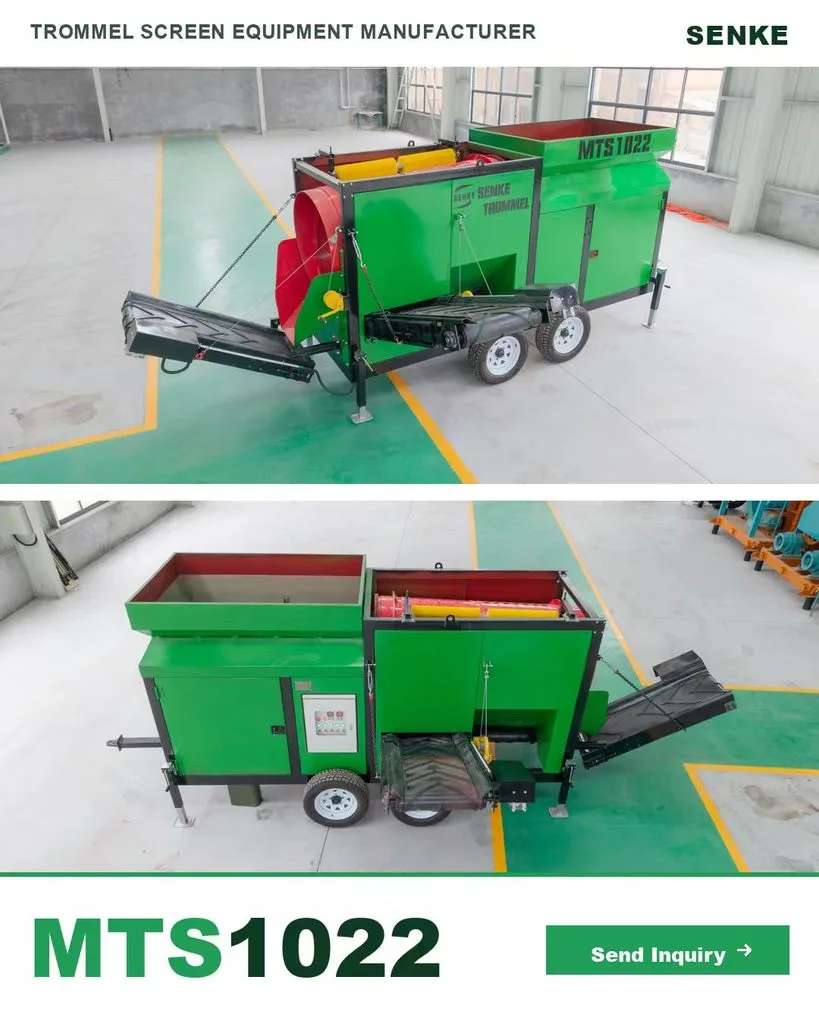
1. Why Flat Vibrating Screens Fail in Wet Topsoil (And Why Trommels Win)
When soil moisture exceeds 15% to 20%, fine silt and organic particles develop high cohesive plasticity. Here is how different machine architectures handle moist earth:
- Flat Vibrating Deck Screens: Vibrating decks use linear or orbital vibration. While efficient on dry sand and gravel, they compress damp topsoil against the flat wire mesh. Sticky clay fills the apertures within minutes, creating an impermeable sheet that forces unscreened dirt over the oversize discharge.
- Rotary Drum Topsoil Screeners: A rotary trommel screener continuously lifts and rolls the soil inside a rotating cylinder. This tumbling motion breaks up soil clumps through natural gravity impact rather than compression.
- Active External Cleaning Brushes: Heavy-duty rotary screeners feature continuous nylon or steel cleaning brushes mounted along the crown of the drum. As the drum turns, the brush bristles push pinned roots and sticky clay back through the apertures, keeping the screening surface 100% open.
2. Technical Specifications: SENKE MTS Series Topsoil Screeners
| Model Specification | SENKE MTS1022 (Compact Mobile) | SENKE MTS1230 (Mid-Range Contractor) | SENKE MTS1550 (High-Volume Industrial) |
|---|
| Drum Diameter | 1,000 mm (3.3 ft) | 1,200 mm (4.0 ft) | 1,500 mm (5.0 ft) |
| Drum Length | 2,200 mm (7.2 ft) | 3,000 mm (10.0 ft) | 5,000 mm (16.4 ft) |
| Processing Capacity | 20 – 45 m³/h (25 – 60 t/h) | 40 – 80 m³/h (50 – 100 t/h) | 80 – 150 m³/h (100 – 190 t/h) |
| Feed Hopper Capacity | 2.0 m³ with grizzly grid | 3.5 m³ with hydraulic tipping grid | 5.5 m³ with remote tipping grid |
| Power Unit | Kubota/Yanmar Diesel (24 kW) / Electric | Cummins Turbo Diesel (38 kW) / Electric | Cummins Turbo Diesel (55 kW) / Hybrid |
| Screen Mesh Options | 6 mm – 25 mm Woven Wire | 8 mm – 35 mm Woven Wire / Perforated | 10 mm – 50 mm Modular Poly / Plate |
| Chassis Setup | Single-Axle Road Towable | Dual-Axle Towable / Crawler Track | Heavy Tri-Axle / Crawler Steel Tracks |
| Stockpiling Conveyor | 650 mm wide, 2.6 m discharge | 800 mm wide, 3.2 m discharge | 1,000 mm wide radial, 4.0 m discharge |
3. Engineering Guidelines for High-Efficiency Soil Screening
To achieve maximum output and clean separation, field operators should implement these four operational practices:
- Optimize Feeder Speed vs. Drum Slope: Set drum inclination between 4° and 6°. Slower rotation with moderate slope increases material retention time (15–22 seconds), allowing 95%+ of fine soil to pass through the mesh before reaching the oversize chute.
- Use Staged Aperture Drum Sections: For rocky topsoil, install a 15 mm perforated plate in the first half of the drum to extract medium stones, followed by a 10 mm fine mesh in the second half.
- Equip Hopper Tipping Grids for Root Scalping: Feeding root-laden turf or tree stump grindings directly into the drum can jam internal lifters. A hydraulic tipping grid on the feed hopper scalps out debris >100 mm before it enters the drum.
- Choose Modular Quick-Change Mesh: In shifting seasonal conditions (dry summer vs. wet spring), modular quick-clamp screens allow two technicians to change aperture sizes in under 30 minutes.
- https://www.zstrommel.com/
- https://cnsenke.en.alibaba.com/
4. Frequently Asked Questions (FAQ)
Q1: What size screen mesh is recommended for premium landscaping topsoil?
A: For commercial bagged or finished landscaping topsoil, an aperture size between 8 mm and 12 mm (5/16″ to 1/2″) produces the ideal texture—clean, aerated, and free of small gravel and root fragments.
Q2: Can a topsoil screener handle compost and wood mulch as well?
A: Yes. Rotary trommel screeners are universal organic separators. By swapping the screen mesh to 15 mm–20 mm, the same machine easily screens aged compost, mulch, wood chips, and garden waste.
Q3: What loader size is needed to feed the SENKE MTS1230?
A: The MTS1230 is designed for versatility. Its 2.6 m loading height and wide hopper accommodate standard skid steers, compact track loaders (CTLs), and wheel loaders with buckets up to 1.5 m³.