Introduction Topsoil screening is an important step in landscaping, gardening, agriculture, construction, and soil recycling. Excavated or reclaimed topsoil often contains stones, roots, clumps, grass, wood pieces, and other unwanted materials. For many applications, simply removing large debris is not…
Introduction
Topsoil screening is an important step in landscaping, gardening, agriculture, construction, and soil recycling. Excavated or reclaimed topsoil often contains stones, roots, clumps, grass, wood pieces, and other unwanted materials. For many applications, simply removing large debris is not enough. Different projects may require topsoil in different particle sizes.
A double deck topsoil vibrating screen provides an efficient solution by using two layers of screen mesh to separate incoming topsoil into three different material sizes during one screening process.
Instead of screening the same material multiple times, the double deck design allows operators to produce three fractions continuously. This can improve productivity while making better use of the processed soil.
For soil suppliers, landscaping contractors, farms, composting operations, and construction companies, a three-way screening system can be a practical choice when different material sizes are required.
What Is a Double Deck Topsoil Vibrating Screen?
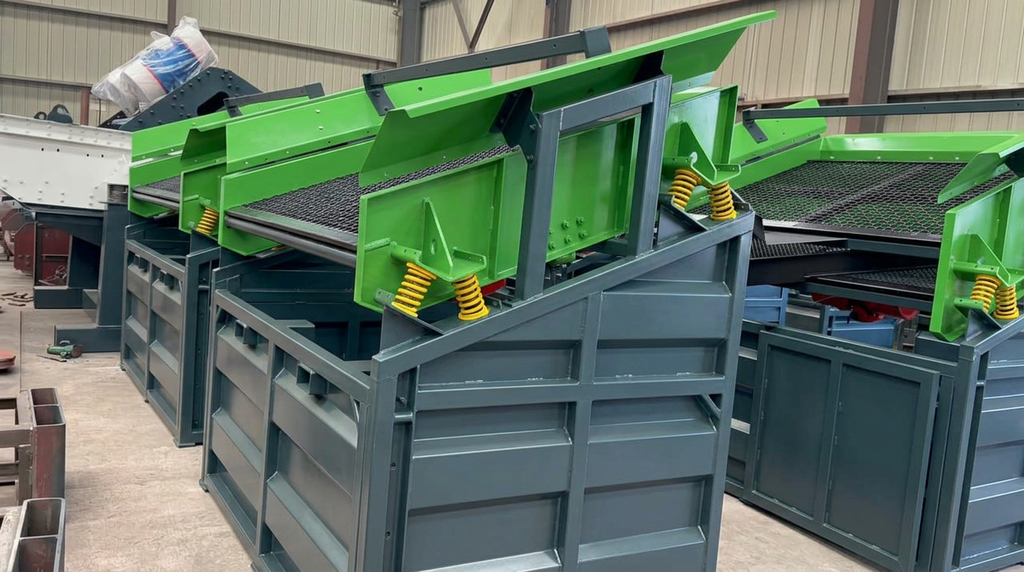
A double deck topsoil vibrating screen is a screening machine equipped with two screening decks.
During operation, raw topsoil is fed onto the upper deck. Vibration moves the material across the screen surface while smaller particles pass through the first screen openings. Material that does not pass through continues toward the second deck.
The second screen separates the remaining material again.
As a result, the machine can produce three different output fractions:
- Oversize material – large stones, roots, wood pieces, and other coarse materials.
- Medium-size material – particles separated through the upper deck but retained by the lower deck.
- Fine topsoil – smaller particles passing through the lower deck.
This makes the double deck design particularly useful when the application requires more than one
finished soil grade.
How Does Three-Way Topsoil Screening Work?
The working process is straightforward.
Step 1: Feed the Raw Topsoil
Excavated or recycled topsoil is loaded into the vibrating screen using a loader, excavator, or other feeding equipment.
The material enters the top of the screening chamber and spreads across the first screen deck.
Step 2: First Deck Separation
The upper screen deck removes the largest particles from the feed.
Large stones, roots, branches, grass clumps, and other oversized materials remain on the upper deck and move toward the oversize discharge.
At the same time, smaller particles pass through the first mesh.
Step 3: Second Deck Separation
Material passing through the first deck falls onto the lower screen.
The second screen uses a different mesh opening to separate the material into another size fraction.
The smaller particles pass through the lower deck and become the fine topsoil product.
Step 4: Three Material Outputs
The complete screening process produces three fractions:
Oversize + Medium + Fine
This three-way separation allows operators to process raw topsoil into different products without requiring multiple independent screening stages.
Why Use a Double Deck Vibrating Screen for Topsoil?
1. Three Material Sizes in One Screening Process
One of the biggest advantages of a double deck topsoil vibrating screen is its ability to produce three material sizes.
For example, depending on the selected screen mesh, an operator can separate:
- Large stones and debris
- Medium-sized soil and aggregate
- Fine topsoil
The exact particle sizes can be adjusted according to the customer’s screening requirements.
2. Higher Screening Efficiency
A double deck screen provides two screening surfaces within one machine.
Instead of processing the same material through separate screening machines, the material can pass through two screening stages continuously.
This can reduce repeated handling and improve overall processing efficiency.
3. Better Topsoil Classification
Different applications require different soil grades.
Fine screened soil may be suitable for lawns, gardens, or seedbeds, while medium-size material can be used for other landscaping or filling applications.
Oversize stones and debris can also be collected separately for recycling or disposal.
The three-way screening process therefore gives operators greater flexibility in how they use their topsoil.
4. Reduced Manual Sorting
Manual soil screening can require significant labor, especially when processing large quantities of excavated soil.
A vibrating screening machine automates the separation process and reduces the need for workers to manually remove stones, roots, and other unwanted materials.
5. Better Utilization of Recycled Topsoil
Topsoil recovered from construction sites, landscaping projects, and land excavation does not always need to be discarded.
After screening, usable soil can be separated from oversized materials and reused.
This can help turn previously mixed excavation material into several usable products.
What Three Materials Can a Double Deck Topsoil Screener Produce?
The specific output depends on the selected screen mesh sizes, feed material, and application.
A typical three-way screening process may look like this:
| Output | Typical Material | Potential Application |
|---|
| Oversize | Stones, roots, wood, debris | Recycling, filling, disposal |
| Medium | Coarse soil, small stones, aggregates | Landscaping, construction |
| Fine | Screened topsoil | Gardening, lawns, agriculture |
The screen openings can be selected according to the desired final products.
For example, a customer who needs very fine topsoil can choose a smaller lower-deck opening, while an operation producing general landscaping soil may use a larger mesh.
Double Deck vs. Single Deck Topsoil Vibrating Screen
Both single deck and double deck vibrating screens can be used for soil screening, but their applications are different.
| Feature | Single Deck Screen | Double Deck Screen |
|---|
| Number of screen decks | 1 | 2 |
| Output fractions | Usually 2 | Up to 3 |
| Screening stages | One | Two |
| Material classification | Basic | More precise |
| Suitable for | Simple soil screening | Multi-size soil screening |
| Product flexibility | Standard | Higher |
If the main requirement is simply to remove large stones and debris from topsoil, a single deck machine may be sufficient.
However, when the customer needs three different material sizes, a double deck vibrating screen is a more suitable solution.
Applications of a Double Deck Topsoil Vibrating Screen
A double deck topsoil vibrating screen can be used in many soil-processing applications.
Landscaping Projects
Landscaping contractors often need screened soil with consistent particle sizes.
The machine can separate fine topsoil from stones and coarse materials, helping prepare soil for lawns, gardens, flower beds, and other landscaping projects.
Garden Soil Production
Garden soil needs to be relatively clean and uniform.
Screening can remove roots, stones, sticks, and oversized clumps while producing finer material for further soil preparation.
Agricultural Soil Screening
Agricultural operations may screen soil before planting or soil preparation.
Three-way classification can provide different material grades for different areas of a farm or agricultural project.
Construction Site Topsoil Recycling
Construction and excavation projects often generate large amounts of mixed soil.
Instead of sending all excavated material away, operators can screen it and recover usable topsoil.
Soil and Aggregate Processing
When topsoil contains a significant amount of small stones or aggregates, the double deck screen can separate soil and coarse materials into different fractions.
Screen Mesh Selection for Three-Way Screening
Screen mesh selection is one of the most important factors when configuring a double deck topsoil vibrating screen.
Because two screening decks are used, each deck can have a different opening size.
For example:
Upper deck: separates large particles from smaller soil.
Lower deck: separates medium particles from fine topsoil.
This creates three output streams.
The correct mesh configuration depends on:
- Desired finished particle size
- Raw topsoil composition
- Stone content
- Soil moisture
- Required processing capacity
- Final application
Customers should select the mesh sizes based on their actual material and finished-product requirements rather than using the same configuration for every project.
Factors That Affect Topsoil Screening Performance
Even with a double deck design, several factors can affect screening efficiency.
Soil Moisture
Wet or sticky topsoil can reduce screening efficiency because soil particles may stick together or block the mesh openings.
For moist materials, appropriate screen mesh and feed control are especially important.
Feed Rate
Overfeeding the machine can create a thick layer of material on the screen surface.
A controlled feed rate allows particles to contact the screen more effectively.
Particle Size Distribution
Topsoil with a large amount of stones, roots, or oversized debris may require appropriate pretreatment or feeding control.
Understanding the raw material helps determine the best screen configuration.
Screen Condition
Regularly checking the screen mesh helps maintain stable screening performance.
Damaged, worn, or blocked mesh should be repaired or replaced when necessary.
Why Three-Way Screening Is Useful for Topsoil Recycling
Topsoil recycling is becoming increasingly important for construction, landscaping, and land development projects.
Excavated soil often contains a mixture of different materials. Without screening, potentially useful soil may be discarded together with stones and debris.
A double deck vibrating screen provides a way to classify this mixed material into different fractions.
The fine fraction can be reused as topsoil, the medium fraction can be used for other applications, and oversized material can be processed separately.
This approach can improve material utilization and reduce unnecessary waste.
SL-VS70 Vibrating Screen for Topsoil Applications
For topsoil screening applications, the SL-VS70 vibrating screen can be configured as a practical soil screening solution.
Its vibrating screening principle provides continuous material movement across the screen surface, while a double deck configuration allows different particle sizes to be separated.
For customers who need to produce three material fractions from topsoil, the two-deck design offers a more flexible screening process than a single-deck machine.
The final configuration, including screen mesh and discharge arrangement, can be selected according to the customer’s material and application requirements.
For more information about screening equipment and available models, visit the SENKE Alibaba Store.
How to Choose the Right Topsoil Vibrating Screen
Before purchasing a vibrating screen for topsoil, consider the following questions:
What Material Are You Screening?
Determine whether the feed consists mainly of topsoil, excavated soil, clay-containing soil, or soil mixed with stones and organic debris.
How Many Products Do You Need?
If you only need to remove oversize materials, a single deck may be enough.
If you need three different material sizes, a double deck topsoil vibrating screen is a better option.
What Final Particle Sizes Are Required?
The required finished size determines the appropriate mesh openings for each deck.
What Is the Required Capacity?
The required processing capacity affects machine size, feeding system, and screen configuration.
Is the Soil Wet or Dry?
Moisture content is important because sticky soil can affect screening performance.
Conclusion
A double deck topsoil vibrating screen is an efficient solution for applications that require more precise soil classification.
With two screening decks, the machine can separate raw topsoil into three different material sizes in a continuous process: oversize material, medium-size material, and fine topsoil.
This three-way screening capability makes the equipment suitable for landscaping, gardening, agriculture, construction-site soil recycling, and general soil processing.
By selecting the appropriate screen mesh and machine configuration, operators can improve screening efficiency, reduce manual labor, and make better use of recovered topsoil.
For projects that require three-way topsoil screening, a double deck vibrating screen can provide a practical and flexible screening solution.
Recommended Image Alt Text
- Double deck topsoil vibrating screen for three-way soil screening
- SL-VS70 vibrating screen for topsoil
- Double deck vibrating soil screener separating three material sizes
- Topsoil screening machine with two screen decks
- Three-way topsoil screening equipment
- Vibrating screen for separating stones and fine topsoil
- Topsoil screener for landscaping and soil recycling
Suggested Internal Linking
You can internally link this article to your existing SL-VS70 topsoil vibrating screen article using anchor text such as:
SL-VS70 topsoil vibrating screen
You can also link to your MTS0818 small mobile trommel screen article for readers who are looking for a mobile solution for soil and compost screening.